
What Is RepMold? How It is Changing Molding Process
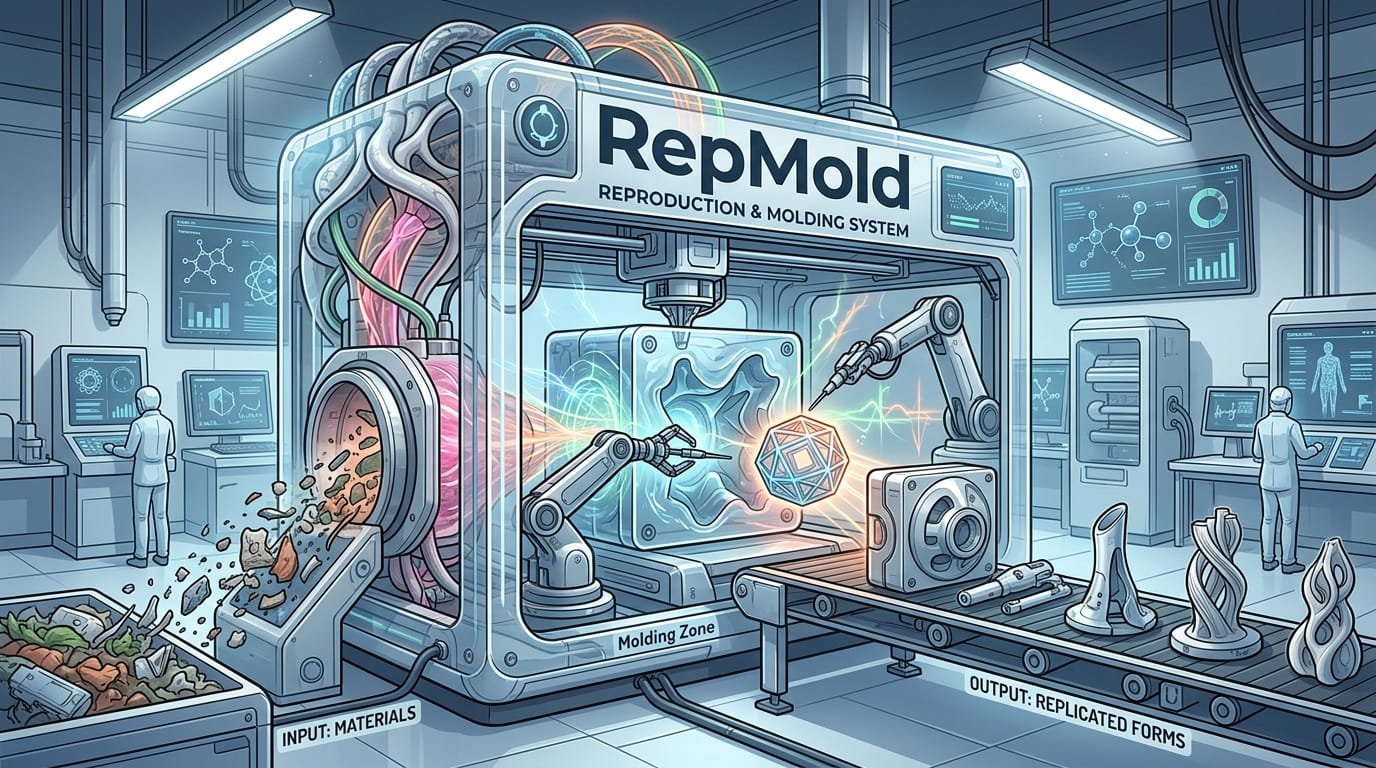
RepMold is best described as an advanced replication molding approach that combines digital design, artificial intelligence, rapid prototyping, and automated manufacturing workflows to accelerate product development and low-to-medium volume production.
Rather than replacing conventional injection molding, RepMold fills the gap between early-stage prototyping and full-scale manufacturing by allowing manufacturers to validate designs, improve performance, and reduce production risk before committing to expensive tooling investments.
As industries continue moving toward Industry 4.0, RepMold is becoming an important part of smart manufacturing and digital transformation strategies for molding processes worldwide.
Table of Contents
Understanding How RepMold Works
RepMold combines several manufacturing molding techniques into a single workflow designed to improve accuracy and reduce development time.
A typical RepMold process includes:
- Digital design creation using CAD software.
- Simulation and stress analysis to identify design weaknesses.
- Prototype fabrication using CNC machining or additive manufacturing.
- Mold creation using flexible or rigid replication materials.
- Component production and quality validation.
Unlike traditional manufacturing processes that often require repeated tooling modifications, RepMold allows engineers to adjust digital models quickly and produce updated components without restarting the entire manufacturing cycle.
For example, a consumer electronics company developing a wearable device enclosure can test multiple design iterations within days instead of waiting several weeks for conventional tooling revisions.
Why RepMold Is Different from Traditional Molding
Traditional injection molding remains the preferred choice for very high-volume production because hardened steel tooling can withstand hundreds of thousands of production cycles.
However, traditional tooling introduces several challenges during product development:
- High upfront tooling costs.
- Long lead times for mold production.
- Expensive design modifications.
- Limited flexibility during prototype validation.
RepMold addresses these limitations by allowing manufacturers to produce highly accurate components during early-stage development while maintaining significantly lower tooling costs.
Repmold is different because of its adaptability and design flexibility, which helps in reducing material waste. Additionally, compared to traditional moulding, it enables us to produce results more quickly because of its advanced technology and proficiency.
| Manufacturing Factor | RepMold | Traditional Injection Molding |
| Initial Tooling Cost | Low to Moderate | High |
| Prototype Iteration Speed | Fast | Slow |
| Design Flexibility | High | Limited |
| Best Production Volume | Low to Medium | High |
| Time to First Part | Days | Weeks |
Rather than competing directly with injection molding, RepMold often serves as a bridge between rapid prototyping and mass production.
The Role of Artificial Intelligence in RepMold
Artificial intelligence improves several stages of the replication molding workflow.
AI-assisted design systems can:
- Analyze stress concentrations.
- Optimize wall thickness.
- Predict material behavior.
- Simulate cooling patterns.
Identify manufacturing defects before production begins.
Machine learning algorithms can also analyze historical production data to improve dimensional consistency and reduce waste over time.
For manufacturers producing highly detailed components, identifying defects before fabrication can reduce development costs and shorten product launch timelines.
Precision Manufacturing and Micron-Level Accuracy
Many industries now require extremely tight tolerances and high structural consistency. RepMold supports precision manufacturing by delivering micron-level accuracy across repeated production cycles.
Replication molding is particularly valuable for industries that require tight tolerances and highly detailed geometries.
Applications include:
- Microfluidic devices.
- Sensor housings.
- Medical device components.
- Electronic connectors.
- Prototype aerospace assemblies.
In these environments, dimensional accuracy directly affects product performance, regulatory compliance, and long-term reliability.
Manufacturers often combine digital inspection systems and automated quality control processes to verify tolerances throughout production.
How RepMold Supports Sustainable Manufacturing?
RepMold supports sustainable manufacturing by turning post-industrial and post-consumer plastic waste into high-quality recycled pellets that can be reused in new molded components. This reduces dependence on virgin resins and supports circular manufacturing practices that keep plastic waste out of landfills.
Unlike traditional grinding methods that can create inconsistent material and surface defects, RepMold uses controlled melting and repelletizing to produce uniform, high-quality feedstock. Integrated degassing systems also remove moisture and trapped gases, improving material consistency and reducing manufacturing defects.
The technology can process a wide range of engineering plastics, including HDPE, LDPE, PP, PA, PC, PU, and ABS, helping manufacturers recover material across multiple production lines while lowering raw material costs and reducing environmental impact.
Rapid Prototyping and Faster Product Development
One major advantage of RepMold is rapid prototyping. Businesses can test product ideas quickly without waiting weeks for traditional tooling processes. Using 3D printing and digital workflows, engineers can build prototype molds within hours. This allows teams to test performance, improve designs, and move into production much faster.
For startups and product developers, this speed creates a major competitive advantage because products can reach the market earlier while maintaining high quality standards.
Industries Benefiting from RepMold Technology
Many industries now depend on RepMold for advanced manufacturing systems and production scalability.
Automotive and Transportation
Automotive companies use replication molding to validate lightweight components, precision parts, interior assemblies and faster prototype testing before investing in full-scale tooling.
Healthcare Manufacturing
Medical/Health manufacturers use replication molding for diagnostic cartridges, prototype surgical tools and custom prosthetic components where precision and repeatability are essential.
Consumer Electronics
Electronics manufacturers benefit from rapid iteration cycles when developing connector housings, wearable devices, intricate casings and compact enclosures.
Aerospace Industry
Aerospace manufacturers frequently require lightweight, high-precision parts where even minor dimensional deviations can affect performance. RepMold helps aerospace companies produce lightweight and durable components with minimal deviation.
RepMold for Small Businesses and Startups
RepMold is no longer limited to large industrial facilities. Affordable desktop manufacturing tools and digital production ecosystems now allow small businesses to adopt the technology more easily.
Startups can use scaled-down systems for prototype validation, limited production runs, and product customization without massive investment costs. This gives smaller companies access to advanced manufacturing capabilities previously available only to large corporations.
As digital manufacturing becomes more accessible, RepMold continues to democratize industrial innovation globally.
Common Challenges in RepMold Adoption
Despite its advantages, RepMold is not the right solution for every manufacturing scenario. One of the biggest considerations is production volume. While replication molding performs exceptionally well for prototyping, bridge manufacturing, and low-to-medium production runs, traditional injection molding often becomes more cost-effective for very high-volume manufacturing where hardened steel tooling can support hundreds of thousands of cycles.
Material selection can also influence project success. Engineers must consider factors such as thermal resistance, chemical compatibility, mechanical strength, and dimensional stability before choosing replication materials for functional testing or end-use applications.
However, improvements in digital simulation, additive manufacturing, and material science continue to reduce many of these limitations, making replication molding increasingly practical for modern product development and agile manufacturing environments.
Conclusion
RepMold represents a practical manufacturing solution that bridges the gap between rapid prototyping and full-scale production. By combining digital design, AI-assisted optimization, and precision replication processes, manufacturers can improve product development speed while reducing risk and tooling costs.
As Industry 4.0 adoption continues to expand, replication molding technologies are likely to become increasingly important for organizations seeking greater flexibility, faster iteration cycles, and more efficient production workflows.
FAQs
What is RepMold in manufacturing?
RepMold is a smart manufacturing technology that combines AI, automation, digital replication, and precision engineering to improve mold production and industrial manufacturing processes.
How does RepMold improve manufacturing efficiency?
RepMold reduces production time, improves dimensional accuracy, minimizes material waste, and supports workflow automation through intelligent manufacturing systems.
Is RepMold part of Industry 4.0?
Yes. RepMold supports Industry 4.0 by integrating automation, IoT sensors, cloud platforms, and data-driven production systems.
Which industries use RepMold technology?
Industries including automotive, aerospace, healthcare manufacturing, consumer electronics, and industrial manufacturing use RepMold for precision fabrication and scalable production.
Does RepMold support sustainable manufacturing?
Yes. RepMold supports eco-friendly manufacturing by reducing material waste, optimizing energy use, and improving production efficiency through intelligent design systems.


